
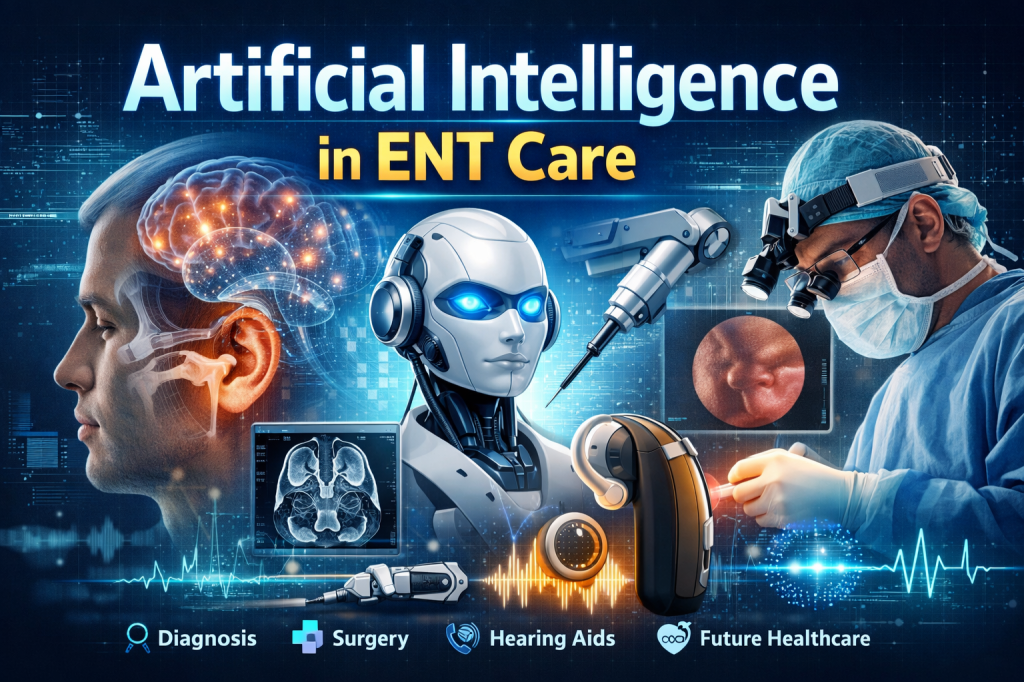
Artificial Intelligence (AI) is no longer a futuristic concept—it is actively transforming ear, nose, and throat (ENT) caretoday. From faster diagnosis to precision surgeries and smarter hearing aids, AI is reshaping how ENT specialists deliver care.
In this article, we explore the latest advancements in AI in otolaryngology (2025–2026) and what it means for patients.
What is Artificial Intelligence in ENT?
Artificial Intelligence refers to computer systems that can analyze medical data, recognize patterns, and assist doctors in decision-making.
In ENT, AI uses:
- Medical imaging (CT, MRI)
- Endoscopy videos
- Audiology data
- Voice analysis
to improve diagnosis and treatment outcomes.
1. AI in ENT Diagnosis: Faster & More Accurate
AI-powered tools are now capable of detecting ENT diseases earlier and with high precision.
Key advancements:
- AI can identify vocal cord lesions and throat cancers with high accuracy
- Automated analysis of CT scans and MRI for sinusitis and tumors
- AI-assisted audiometry for early detection of hearing loss
AI reduces human error and helps ENT specialists make faster, evidence-based decisions.
2. AI in Imaging & Radiology (Biggest Current Trend)
The biggest shift in recent years is the use of AI in:
- CT scans
- MRI
- Radiomics (advanced imaging analysis)
AI can detect subtle abnormalities that may be missed by the human eye, especially in:
- Head and neck cancers
- Chronic sinusitis
- Middle ear diseases
Recent research shows a strong trend toward AI-driven imaging and radiomics in ENT care.
3. AI-Assisted ENT Surgery
AI is improving surgical precision through:
- Robotic-assisted surgery
- Real-time navigation systems
- Intraoperative decision support
These technologies help surgeons operate with millimeter-level accuracy, reducing complications and recovery time.
AI is also being used in:
- Cochlear implant surgery
- Skull base surgery
- Transoral robotic surgery
AI-supported surgical workflows are becoming a major part of modern ENT practice.
4. Smart Hearing Aids & Cochlear Implants
Modern hearing devices now use AI to:
- Automatically adjust to surroundings
- Reduce background noise
- Enhance speech clarity
Some AI hearing aids can even learn user preferences over time, offering a personalized listening experience.
AI is also improving outcomes in cochlear implants, helping patients understand speech better.
5. Personalized ENT Treatment
AI enables personalized medicine by analyzing:
- Patient history
- Lifestyle
- Imaging data
- Sleep studies
Examples:
- Customized treatment for sleep apnea
- Targeted therapy for chronic sinusitis
- Predicting disease progression
This leads to better outcomes and fewer unnecessary treatments.
6. AI in Telemedicine & Home Monitoring
One of the fastest-growing trends is AI in remote ENT care:
- Smartphone otoscopy for ear infections
- Voice analysis apps for vocal disorders
- Wearables for sleep apnea monitoring
Patients can now get early screening without visiting a clinic, improving access to care.
7. AI in Clinic Workflow & Patient Experience
AI is also helping ENT clinics run more efficiently:
- Automated medical documentation
- Smart appointment scheduling
- AI chatbots for patient queries
This reduces doctor workload and allows more focus on patient care.
Challenges & Ethical Considerations
Despite its benefits, AI comes with challenges:
- Data privacy concerns
- Risk of bias in algorithms
- Overdependence on technology
Importantly, AI is designed to assist—not replace—ENT specialists. Clinical judgment remains essential.
Future of AI in ENT (What’s Coming Next?)
Emerging trends include:
- Real-time AI during endoscopy
- Predictive analytics for cancer outcomes
- Advanced voice biomarkers
- AI-guided drug development
AI is expected to become a core part of ENT practice in the next 5–10 years.
What This Means for Patients
For patients, AI means:
- Earlier diagnosis
- More accurate treatment
- Less invasive surgery
- Better hearing solutions
In simple terms: faster, safer, and smarter ENT care.
Final Thoughts
Artificial Intelligence is revolutionizing ENT care—from diagnosis to surgery and beyond. While challenges remain, the future is clearly moving toward AI-assisted, patient-centered healthcare.
FAQs
What is AI in ENT care?
AI in ENT refers to the use of machine learning and data analysis to assist in diagnosing and treating ear, nose, and throat conditions.
How is AI used in ENT diagnosis?
AI analyzes scans, endoscopy images, and hearing tests to detect diseases early and accurately.
Can AI replace ENT doctors?
No. AI supports doctors but cannot replace clinical expertise and decision-making.
Is AI used in hearing aids?
Yes. Modern hearing aids use AI to improve sound clarity and adapt to environments.
 Dr. Preethi Umamaheswaran MS DNB (ENT)