
The aim of vestibular rehabilitation is to help the patient recover from residual symptoms of vertigo that might persist with medical treatment. Vestibular rehabilitation is usually initiated as an adjuvant therapy to medication. Start these exercises after consulting with your ENT specialist.
The following exercises are taught as a part of vestibular rehabilitation
1) Epley’s Maneuver
2) Semont (Liberatory) maneuver
3) Brandt-Daroff exercises.
Epley’s Maneuver:
- Done to reposition the floating debris in the semicircular canal (SCC).
- Head is moved into different positions in a sequence. This will more the debris out of the involved SCC.
- Used in posterior and anterior SCC vertigo
Steps of Epley’s maneuver:
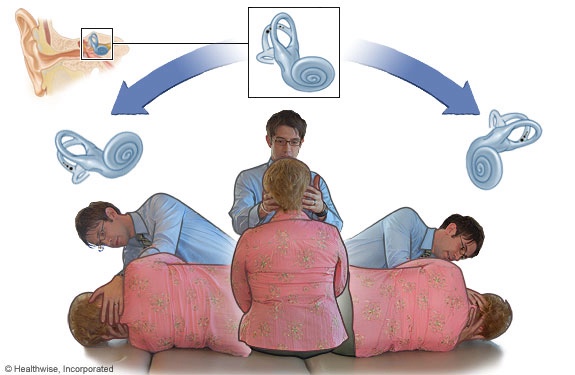
- Head is turned approximately 180° to the left while keeping the neck extended with the head below the level of gurney.
- Patients head is further rotated to the left by rolling onto the left side until the patient’s head faces down.
- Now the patient is brought back to upright position.
This maneuver repositions the debris in SCC
Precautions to be taken after performing Epley’s repositioning maneuver:
Avoid sudden head movements for a couple of days after the maneuver, as it may dislodge the otoconia and render the maneuver ineffective.

Semont (Liberatory) maneuver:
- Involves rapidly moving the patient through positions designed to dislodge the debris from Cupula.
- It is considered as an alternative treatment.
- It may be more difficult for the patient to tolerate
Steps of Semont maneuver:
- The head is rotated 45 degrees to the left side.
- With assistance, the patient is moved from sitting to right sidelying and stays in this position for 1 min.
- The patient is then rapidly moved 180 degrees, from right sidelying to left sidelying.
- After 1 min in this position, the patient returns to sitting.
Brandt-Daroff exercise:
- Helps to habituate the central nervous system to the provoking position.
- It should be performed in 5 to 10 repetitions, three times a day until the patient has no vertigo for two consecutive days.
- This exercise may provoke the patient’s vertigo. However any residual symptom is only temporary.
Steps of Brandt-Daroff exercise:
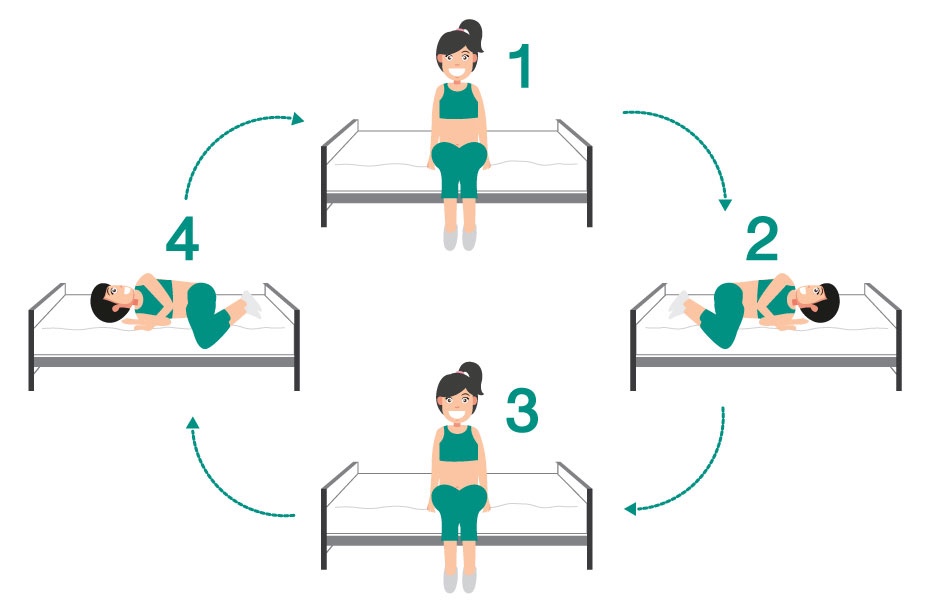
- Sit on the edge of the bed and turn your head 45° to the right.
- Quickly lie down on your left side and wait 15 sec before sitting up.
- Sit up and wait another 15 sec with your head turned the entire time.
- Now turn your head to the left and lie down quickly on your right side.
- Wait 15 sec and then sit up, wait for 15 sec. Keep your head turned the entire time

 Dr. Preethi Umamaheswaran MS DNB (ENT)